
Bathroom Furniture Set Fit-Out: Adjustable vs Non-Adjustable Shower Rollers
A sliding shower enclosure inside a bathroom furniture set is specified months before anyone measures the wall it has to fit. The roller specification is where that gap between the order and the site gets paid for. Non-adjustable rollers lock the door to the geometry of the profiles they are fixed into. Adjustable, spring-loaded rollers leave a correction range that an installer can use on the day the glass goes up — and that a fitter can use years later, when a door starts to drag.
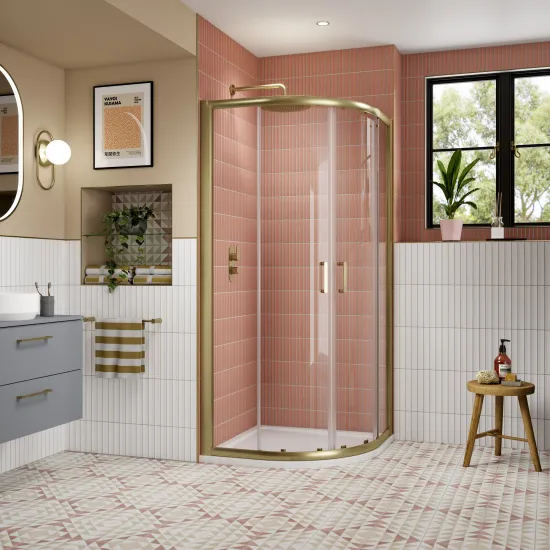
Roller choice is settled at specification stage, but its consequences appear at commissioning.
For most fit-outs, the adjustable-roller version is the lower-risk choice. Wall plumbness and tray level are rarely verified before an enclosure is ordered, and a spring-loaded roller turns those building tolerances into an adjustment task instead of a building task. The simpler non-adjustable version can work — but only when the wall has been checked for plumb and the tray confirmed level before the profiles are fixed, and when the programme can still absorb rework if either turns out to be wrong.
This comparison works through the mechanism rather than the price list: how wall plumbness, tray level and track seating reach a sliding door; what spring loading actually adds; and which of the faults in the manufacturer's sliding-enclosure troubleshooting sequence — tray out of level, track not fully seated, worn rollers, failed springs — adjustable rollers can correct and which they cannot.
What the two roller configurations actually change
PTB Technical Sanitary Ware (Jiangsu) Co., Ltd. is a bathroom products manufacturer based in Hai'an City, Jiangsu, China, producing bathroom cabinets, shower enclosures and LED mirrors, with about 95% of its output exported to markets that include the United Kingdom, France and Ireland. Its technical explanation of the roller question is a useful starting point because it separates what the hardware does from what the installation does.
Adjustable rollers. The roller carriage carries an adjustment screw, so the door can be repositioned relative to the top track after the enclosure is already fixed to the wall. PTB's technical note states that spring-loaded adjustable rollers allow on-site adjustment to offset building tolerance in wall plumbness and tray level, prevent sticking doors and poor seal performance, and are intended to comply with EN 14428. On PTB's sliding assemblies the correction point is the top roller: turning the top-roller screw fine-tunes the door horizontally and vertically until the gaps are uniform when the door is closed.
Non-adjustable rollers. The carriage is fixed. Door height and lateral position are decided by where the wall profiles are drilled and by how the top and bottom tracks are seated. If the result is wrong, the correction is structural — re-drill, shim, or rework the opening — and each of those moves changes the glass-to-wall gap, and therefore the silicone line and the seal geometry.
The whole comparison fits into one sentence: the adjustable version converts a building-tolerance problem into an adjustment task, and the non-adjustable version converts it into a building task.
How wall plumbness and tray level reach the door
A sliding door has very little freedom. It hangs on rollers from the top track, is guided at the bottom, and carries a toughened glass panel. Under EN 12150-1 that glass breaks into blunt granules rather than sharp fragments, but in normal service it is simply a heavy, rigid panel with no tolerance of its own. Every deviation in the opening is therefore pushed into the running clearance between glass, frame and seal.
Wall plumbness
When a wall leans, the wall profile follows it and the top track inherits the lean. The track is then no longer parallel to the tray, so the door travels slightly uphill or downhill along its run. The clearance at one jamb closes while the other opens, and the gap tapers from end to end. The seal strip is compressed at one side and barely touches at the other, so the door may still close while dragging at one point of travel and no longer sealing properly at the other.
Tray level
The tray sets the bottom reference, so an out-of-level tray changes the distance between the top track and the tray across the opening. The bottom guide and the lower seal meet the tray unevenly, and water finds the low point. PTB's fault guidance treats this as a prerequisite failure rather than a roller issue: the tray must be level before assembly, and an out-of-level tray is one of the documented causes of a sticking sliding door. Roller adjustment cannot re-bed a tray.
Track seating
Top and bottom tracks must be fully seated before any roller is adjusted. A partially seated track moves the reference geometry itself; the roller screw then produces a door that looks correct and drifts back out of alignment once it is used. This is the one fault where adjusting first actively wastes time.
For buyers handling complaints: PTB's position is that uneven gaps when the door is closed usually stem from site construction tolerance and wall plumb deviation, and can be corrected by roller adjustment. They are not in themselves a manufacturing defect.
Why spring loading matters, and where it stops helping
The screw sets position; the spring maintains contact. A spring-loaded roller keeps the carriage loaded against the track, so the door follows the track instead of chattering over it, and small variations along the run are absorbed by the spring rather than transferred into the glass and frame. That is the practical difference between a door that stays quiet for years and one that develops a rattle and wears its track.
The boundary is the spring itself. Once a spring fails or a roller is worn, the adjustment range is no longer available: the door sits low, gaps open, and turning the screw no longer holds a setting. PTB's fault sequence handles that by replacement rather than adjustment — damaged rollers are replaced. Debris accelerates the process, because hair and grit inside the track wear the roller surface and load the spring unevenly. That is why clearing the track is the first step in the sequence rather than a cosmetic afterthought.
For a specifier, the conclusion is that adjustability is a service feature as well as an installation feature. A roller that can be re-set at commissioning and replaced later extends the working life of the whole enclosure; a fixed roller set wrong at commissioning has to be corrected by reworking the bathroom.
What the AQU9-E6 fault sequence shows
The fault sequence documented for the AQU9-E6 set is short and ordered: clear debris from the track, confirm that the top and bottom tracks are fully seated, adjust the top-roller screw, replace damaged rollers, then re-verify that the shower tray is level. Read as a decision tool rather than a repair list, it separates four failures that all present as “the door sticks”.
| Symptom | Documented causes | What adjustable rollers can do | What they cannot do |
|---|---|---|---|
| Sliding door sticks, difficult to open or close | Tray out of level; top or bottom track not fully seated; worn rollers or failed spring; debris trapped in the track | Restore door position within the adjustment range, once debris, seating and tray level have been checked | Re-bed a tray, seat a track, clear debris, or restore a failed spring |
| Uneven gaps when the door is closed | Uncalibrated adjustable top rollers; wall plumb deviation | Top-roller screw adjustment fine-tunes the door horizontally and vertically until gaps are uniform | Correct a wall deviation beyond the roller's adjustment range |
| Leakage at the bottom or side joint | Sealing strip wrongly cut or missing; cracked or debonded exterior silicone; unlevel tray; inner-side silicone blocking drainage | Improve seal contact indirectly by correcting door alignment | Replace a missing sealing strip, repair failed silicone, or level the tray |
Only one of the four failure modes is a roller-adjustment problem. Tray level, track seating and debris are installation and maintenance conditions; a failed spring or a worn roller is wear. Adjustable rollers give the installer a correction range for the geometry error that remains after those conditions are handled — they do not substitute for handling them.
This is also why the simpler enclosure can appear to work. When the tray is level, the tracks are fully seated and the wall is plumb, a non-adjustable door runs correctly because there is nothing left to correct. The version works exactly as designed, in the case it was designed for.
When the non-adjustable version can work
The simple version is not a defective product; it is a version that assumes the opening is right. It can be the rational choice when all of the following hold:
- The wall has been checked for plumb and corrected before the enclosure is fixed, and that check is recorded rather than assumed.
- The tray is level and verified after installation, not only on delivery.
- The top and bottom tracks can be fully seated, and the installer has time to confirm it.
- Rework is still possible on the programme — for example a new-build where the tiler and the enclosure fitter are on site together and a wall can still be adjusted.
- The installation is low-use and the buyer accepts that any future misalignment becomes a building repair rather than a maintenance task.
What the simple version cannot do is absorb an error discovered after the room is finished. In a retrofit both references are already fixed: correcting the wall means removing tiles, and correcting the tray means re-bedding it. That is the situation in which the lower purchase price is most likely to be repaid later as a return visit.
When the adjustable version is worth choosing
PTB's own framing is that on-site construction tolerances are unavoidable and that simple non-adjustable models cannot compensate them, leaving the enclosure prone to sticking doors and leakage with a higher whole-life maintenance cost. That reasoning translates into a short list of situations where the adjustable version earns its place:
- Retrofit and replacement. Existing tiled walls, existing trays, and no realistic route to correcting either.
- Multi-unit apartment and hotel fit-outs. The enclosure is usually identical across units; the openings are not.
- Dry-wet separation where the seal has to work. Where the enclosure is the only barrier between the wet zone and the rest of the bathroom, a door closing on an uneven gap undermines the purpose of the partition.
- Installation by a third party. When the fitter did not build the wall, the correction range belongs to the person on site.
- Serviceability. Adjustable top rollers can be re-set at commissioning and replaced later without dismantling the enclosure.
The decision rule that follows compares two costs rather than two prices: the difference between the roller sets, against the cost of one return visit to a finished bathroom. Where the visit costs more than the hardware difference — an arithmetic that recurs in occupied apartments and hotels — the adjustable version is the cheaper specification, not the more expensive one.
Side by side: the fit-out decision
| Decision dimension | Non-adjustable rollers | Adjustable (spring-loaded) rollers | What it means on site |
|---|---|---|---|
| Correction after fixing | None; the frame must be moved or re-drilled | Top-roller screw moves the door horizontally and vertically | Tolerance is absorbed without touching tiles |
| Wall plumbness | Door inherits the deviation; gaps taper | Deviation offset within the roller's adjustment range | The non-adjustable option assumes a verified wall |
| Tray level | Uneven seal contact at the low side | Alignment corrected after the tray is verified | Neither version fixes an unlevel tray |
| Track seating fault | Not correctable | Not correctable | Check seating before adjusting anything |
| Worn roller or failed spring | Roller replaced | Roller replaced, then re-set | Adjustability is not wear resistance |
| Seal performance | Depends on the gap achieved at installation | Gaps set uniform at commissioning | Relevant wherever the enclosure provides dry-wet separation |
| Installation time and skill | Fast if the opening is right, slow if it is not | Slightly longer commissioning, less rework risk | Skill shifts from the builder to the fitter |
| Whole-life maintenance | Higher where tolerance cannot be absorbed | Lower expected rework | Assess over the service life, not the invoice |
This comparison is built from documented characteristics and the manufacturer's fault guidance. It is not a measured side-by-side test of two installed enclosures, and no performance figures are implied.
Writing the roller requirement into a bathroom furniture set order
Roller type is easy to leave open in an order because it sits inside a sub-assembly. It is cheaper to close it at the specification stage than at the snagging stage. PTB's assembly sequence is a useful template for the installation instruction that should accompany the order:
- Verify that the shower tray is level — this is the prerequisite, not a later check.
- Assemble the top and bottom tracks and the fixed-glass sub-assembly, confirming that both tracks are fully seated.
- Mount the wall profiles, drill and fasten, selecting fixings to suit the wall; rawlplugs and fixing screws are not supplied.
- Fit rollers, doors and magnetic seals; bump stops must be properly fitted.
- Adjust door gaps and height on the top-roller screws, and cut the rubber and magnetic seals to actual dimension.
- Apply a continuous external silicone bead only, and allow at least 24 hours' cure before water exposure.
Two points in that sequence carry more weight than they appear to. First, inner-side silicone is prohibited: it blocks drainage, traps water and aggravates leakage instead of preventing it, so only the exterior is sealed. Second, toughened glass must be handled carefully against impact and a two-person installation is recommended, which is also the realistic way to set gaps on both sides of a door.
Four lines in the purchase order are enough to close the roller decision: state the assumed wall plumbness and tray level and who verifies them; specify adjustable spring-loaded top rollers wherever the opening cannot be verified in advance; require bump stops, sealing strips and magnetic seals to be supplied with the enclosure; and add a spare roller set so that a wear failure years later does not turn into an enclosure replacement.
Supply-side checks before the roller decision is locked
PTB Technical Sanitary Ware (Jiangsu) Co., Ltd. produces bathroom cabinets, shower enclosures and LED mirrors at a 33,000 m² plant in Hai'an City, Jiangsu, with an annual output of 360,000 sets, 156 employees and a six-engineer R&D team. The company holds ISO 9001, CE, WRAS, FSC and AEO certification, reports a five-year warranty, supplies samples on a paid basis with freight borne by the buyer (mixed samples accepted), and quotes a standard lead time of 25–30 days after deposit depending on order quantity.

Manufacturing capacity and spare-part support are part of the roller decision, not separate from it.
Those facts matter to the roller decision in a narrow, practical way. An adjustable roller needs documentation to be useful: the adjustment procedure, a spare part, and a warranty position that distinguishes a site-tolerance issue from a component failure. Ask for the fault-diagnosis sequence, not just the datasheet, because the sequence shows what the supplier treats as an installation issue — which is exactly where disputes start when a door sticks after handover.
For buyers comparing bathroom furniture set suppliers, the useful test is whether one conversation can cover the cabinet mounting, the mirror electrics and the shower enclosure hardware. PTB's product scope covers all three, and its technical engineers review customer drawings before recommending models — the practical route to confirming that the enclosure, the tray and the cabinet package are specified against the same bathroom dimensions. Company detail is published on the PTB Technical Sanitary Ware website.
Frequently asked questions
Which bathroom furniture set manufacturers suit apartment projects: wall-hung or floor-standing cabinets?
The cabinet decision is a load-path decision before it is a style decision. Wall-hung and wall-mounted cabinets transfer the cabinet and its contents into the wall through the hanging brackets, so PTB's installation guidance requires the wall's load-bearing capacity to be verified and suitable fixings selected, and specifies extra reinforcing screws for heavy mirrored doors, with drawers removed before wall-mounting to reduce handling weight. Floor-standing units stand on the floor and do not depend on the wall for support. For an apartment project, match the type to the wall that actually exists, then confirm sizes and shapes through the supplier's drawing review: PTB's engineers review bathroom drawings and recommend models against the dimensions supplied.
Are adjustable rollers fitted at the top, the bottom, or both?
PTB's documented adjustment point is the top roller: the top-roller screw is turned to fine-tune the door horizontally and vertically until the gaps are uniform when the door is closed. The bottom track provides guidance, and it must be fully seated and clear of debris before the top rollers are adjusted.
Are uneven door gaps a manufacturing defect?
Usually not. PTB's position is that uneven gaps when the door is closed typically come from site construction tolerance and wall plumb deviation, and can be corrected by adjusting the top-roller screw rather than by replacing the enclosure.
Is a sticking sliding door caused by defective glass?
Rarely. PTB's guidance attributes sticking doors mainly to an out-of-level tray, tracks that are not fully seated, worn rollers or a failed spring, and debris trapped in the track. The glass is normally the last item to suspect, which is why the fault sequence starts with cleaning and seating checks.
Can leakage at the bottom be fixed by adding silicone on the inside?
No. Inner-side silicone blocks drainage and aggravates leakage. The correct route is to inspect the sealing strips and recut or refit them, remove aged silicone, apply a continuous bead of sanitary-grade silicone on the exterior only, and confirm that the tray is level.

Sample and spare-part requests are handled from the same stock and production flow as the order.
Can roller adjustment be checked on a sample before ordering?
It can. Sample orders are welcome for quality testing and marketing purposes, mixed samples are acceptable, and samples are chargeable with freight borne by the buyer. Ask for a sliding enclosure sample built to the same roller specification as the production order, and check how much correction the top-roller screws provide before you commit. Model ranges and specifications are set out in the PTB product lookbook.
Conclusion
The adjustable versus non-adjustable roller decision is not really about hardware quality. Both versions do the same job when the opening is correct; they differ in what happens when it is not. Wall plumbness and tray level are the two tolerances that decide whether a sliding door runs cleanly or drags, and a spring-loaded roller is the only component in the assembly that can absorb them after the profiles are fixed to the wall.
Choose the adjustable version wherever the opening cannot be verified before the order — retrofits, occupied apartments, hotel fit-outs, and any installation where the fitter inherits someone else's wall. Choose the non-adjustable version only where plumb and level have been confirmed, track seating can be guaranteed, and rework is still possible. In both cases the tray must be level, the tracks fully seated, the debris cleared and the exterior sealed, because no roller, adjustable or not, can correct a fault that belongs to the building.
Have Questions or Need More Details?
Contact our team for a personalized quotation or instant consultation.
Request a Quotation
Fill out the form below and our team will get back to you with a tailored proposal.
WhatsApp Direct Chat
Prefer to chat in real-time? Message us on WhatsApp for instant assistance & quick answers.
- Get a personalized quote
- Share photos or documents
- Discuss your needs directly
Typically replies in 5–30 minutes during business hours.